'1,800 mph' that appears in no document: the black triangle, the 'Skinwalker' hair, and what the seventh release really contains
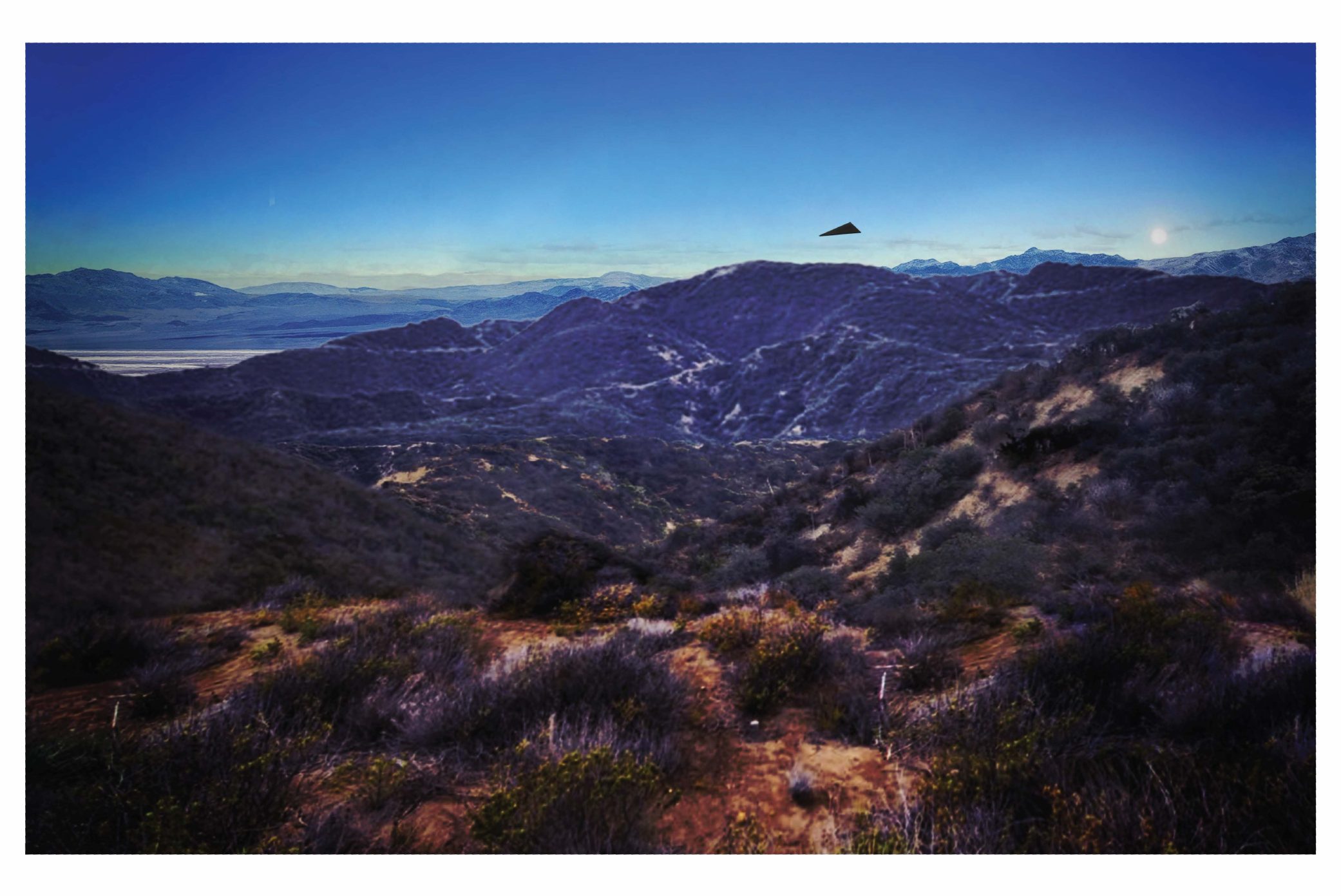
On October 23, 2026, the Department of War published the seventh PURSUE release (war.gov/UFO): 28 documents, no videos. They are already complete in our archive. The headline that traveled furthest came from the New York Post: black triangles 'going 1,800 mph' over secret military bases. We went to the documents.
The triangle exists in two accounts of the same episode: the statement two federal agents signed for the FBI (form FD-302) and the memo by AARO, the Pentagon's anomalous phenomena office, after interviewing them. Place and date are redacted. What they say: at night, from an observation post, they saw a matte black triangular object —9 to 15 feet across per the FBI, 13 to 15 per AARO— climb vertically for about 10 seconds over a ridge, hover motionless for about 20, and leave in 2 or 3 seconds in a terrain-hugging dash into a canyon. AARO sums it up with a phrase that is verbatim: 'absolute acoustic silence'. The witnesses work with drones and say a drone or helicopter at 1.4 miles would have been audible on that hilltop; the next morning they found nothing in the canyon.
Now, the 1,800 mph. It appears in none of the 28 documents: we checked by searching the full text of the release. The Post itself explains it is its own arithmetic: '1.5 miles in three seconds'. But in the FBI statement, 1.5 miles is how far the agents were from the object when they lost sight of it, not how far it traveled; and 'three seconds' appears as the total length of the sighting, which in AARO's account adds up to more than 30 seconds. Dividing one by the other does not give a speed. AARO also says it plainly: 'no instrumented speed measurement was obtained'; the witnesses compared it to a fighter jet. And it opens its memo with a warning: the report 'reflects the reporter's interpretation' and is not a conclusive indication of what the object can do. We could not find the Post's 'three separate occasions' either: the release holds one episode with two accounts. If there are more, they would come from the briefing given to reporters, which is not public.
That does not make it a non-case. Two federal agents, a third corroborating witness, size estimates against the treeline and a formal AARO debrief: it is among the best-documented material PURSUE has put out. It remains unexplained. But the speed is exactly what we do not know.
The other half of the release is BAASS's internal paperwork. BAASS is Robert Bigelow's company, which from 2008 to 2010 carried out the Defense Intelligence Agency contract known as AAWSAP. It includes the management plan, monthly reports and the March-April 2010 investigation at the Utah ranch popular culture knows as Skinwalker. That is where the story the press told by halves lives: a rancher said his dogs chased a 'Skinwalker' through his barbed-wire fence, and BAASS sent the hair left on the wire for analysis. The report itself has the result: the fence hair and two other samples gave the same dog DNA sequence, and the lab writes that this, plus the dogs that roam the property freely, 'strongly argue' they come from the same animal as the control sample taken from a dog on the property. It flags this as not 100% definitive. The hair found on a red-stained rock was a raccoon's. The seven game cameras record nothing anomalous in the report, and the 'biosensor' plants showed no mutations.
The papers do offer material for anyone who wants to see the big picture. In 2008 BAASS asked the DIA to arrange access to military labs 'under the premise that biological material of potentially non-human origin has been recovered', and in 2009 it describes an underground vault to store 'exotic material or tissue'. These are requests and plans: no document records that it obtained any. Some details need care when repeated. The acronym AAWSAP does not appear in these papers; the program's name and amount ($21,948,810) come from the sixth release. Robert Bigelow's name does not appear either: only 'BAASS's sister company Bigelow Aerospace'. The 'largest known UAP data warehouse in the world', with 234,364 reports since 593 B.C., includes duplicates and already-explained cases, by the same text's own account.
Finally, Catalina. Several outlets presented the island off Los Angeles as a 'hot spot' with four 'unresolved' cases from 1949 to 1955. The label comes from the release index, not the files. The 1955 file concludes 'probable meteor'; the 1953 one, 'astronomical (Jupiter)', with Griffith Observatory astronomers thinking they were 'possibly planets'; the 1949 one says 'insufficient data for evaluation', and only the 1952 one —three Boy Scouts and a silver object that 'disintegrated'— remains unexplained. We tell it in full, with the 1949 letter addressed to Kenneth Arnold, in our note on Catalina.
That is the rule we read every release by: what the document says, kept apart from what it is said to say. Everything cited here can be opened and read in full in our archive.