Catalina, a UFO 'hot spot'? What the four files really say — and the letter an island resident sent to Kenneth Arnold
The seventh PURSUE release (war.gov/UFO, October 23, 2026) included four files on Santa Catalina Island, off Los Angeles, from 1949, 1952, 1953 and 1955. The official index titles all of them 'Unresolved UAP Report', and local outlets presented them as proof that the island was a UFO 'hot spot'. All four are complete in our archive. We read them page by page, on the image and not just the extracted text, because automatic text recognition swallowed key lines.
They are Project Blue Book cards, from the US Air Force investigation ('Project 10073 Record' format). Each has a conclusion box. This is what they say.
1949: a letter to Kenneth Arnold. The smallest file holds the best surprise. It is a handwritten letter dated in Avalon, the island's town, on May 1, 1949, addressed to 'Kenneth Arnold, Boise, Idaho': the pilot whose sighting of nine objects near Mount Rainier in June 1947 gave rise to the phrase 'flying saucers'. The writer says that around eight in the evening on April 28 his wife and a schoolteacher saw 'six objects in the sky, not in a group, but singly', and that minutes later his wife, daughter and grandson saw four more, all heading the same way. He offers to write more 'if you are still interested in flying disks'. The letter ended up in military files: a routing slip records that it came from the 17th District at Kirtland Field (New Mexico) on May 26, 1949, and a handwritten note says the Air Materiel Command intelligence office (MCIAXS) 'did not acknowledge this letter'. The file does not explain how it got from Arnold to the Air Force. The card's conclusion: 'insufficient data for evaluation'. The card records six objects and leaves out the letter's other four.
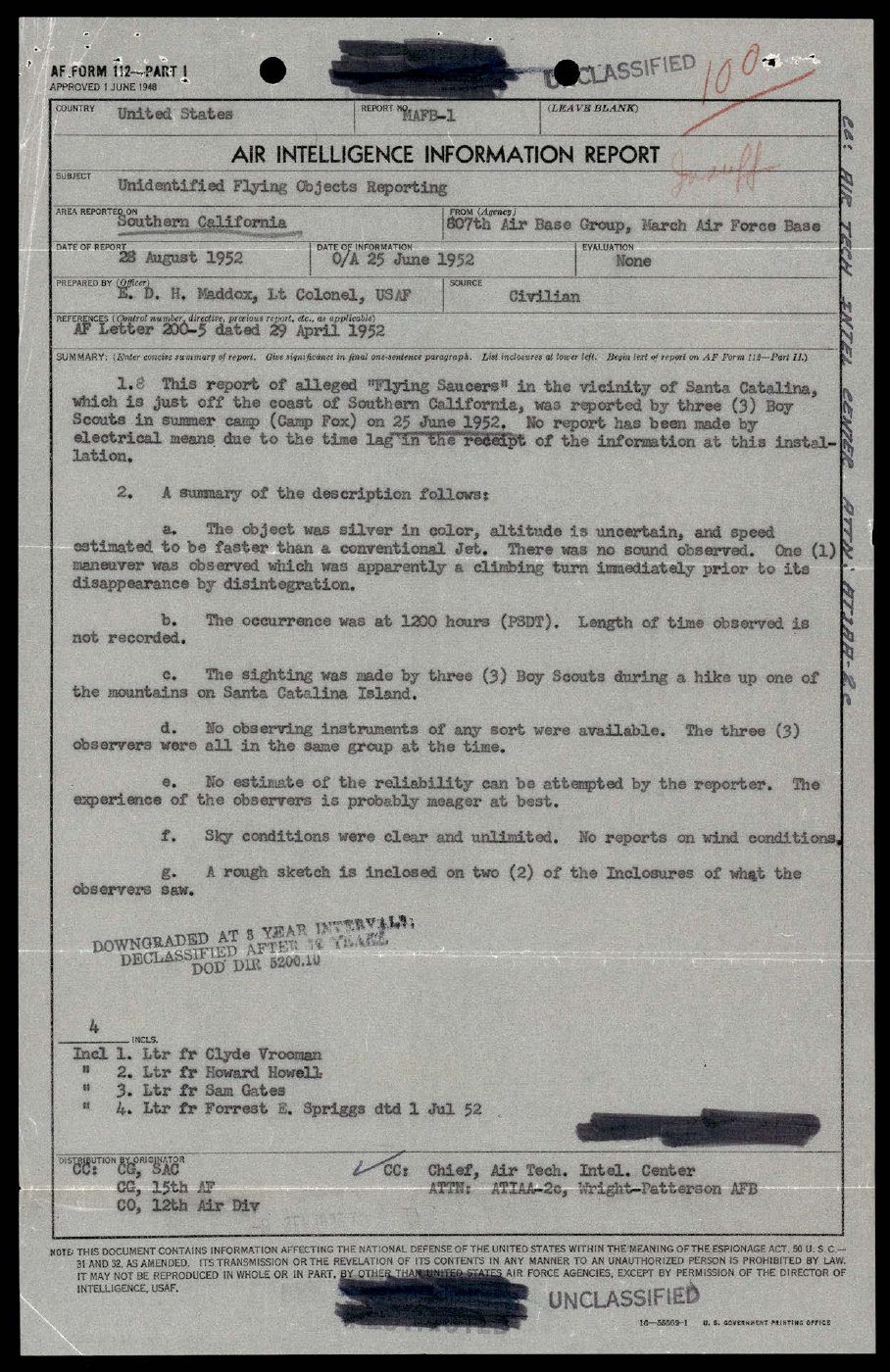
1952: the three Boy Scouts. This is the case with the most substance, and the only one the Air Force did not explain. Three scouts from Camp Fox, hiking up a hill on the island around noon on June 25, 1952, saw a silver object, with no sound, 'faster than a conventional jet', that made a climbing turn and then vanished 'by disintegration'. March Air Force Base wrote the report two months later, on August 28, and explains it was not wired because of that delay. The officer wrote that he could not estimate the witnesses' reliability and that their experience was 'probably meager at best'. The report says a sketch is enclosed in two of its four attachments, but those attachments are not in the published file, which has only two pages. The card sums it up as 'Disintegrated'. In our copy, the conclusion box is not legible.
1953: Jupiter. Before dawn on November 16, 1953, an Air Force technical sergeant in San Pedro watched for ten minutes a round point 'the size of a pea', purplish white, that seemed to hang over Catalina and then moved toward Los Angeles in a straight line. The report calls him 'fairly reliable' because he had worked with jet aircraft. The card's conclusion is 'Astronomical (Jupiter)'. It notes that the movement did not match the winds aloft (which rules out a balloon) and that Griffith Observatory astronomers thought objects like this were 'possibly planets, which appear more clearly after rainfall'. The analyst even jotted down Jupiter's position that night. A refinement of our own earlier note, which quoted only the 'possibly planets' line: the card's conclusion says Jupiter in so many words. That line was lost in the extracted text and only shows on the image.
1955: a two-second meteor. On the afternoon of March 15, 1955, a civilian saw an object 'approximately the size of a nickel held at arm's length', very bright and orange, fall straight down near the island in about two seconds. There are two cards for that day. One says 'probable meteor'; the other says 'possibly astronomical' and that, given how brief the sighting was, the unit did not consider further investigation worthwhile. The teletype concludes that the flight path and duration suggest it was 'probably a meteor'.
The tally: of four files, two have an astronomical explanation on their own card, one lacks enough data and one, the scouts', remains unexplained. Calling all four 'unresolved' is a label from the release index, not what the Air Force concluded. And four reports in six years, on an island in plain view of a city of millions and in the middle of the postwar sighting wave, do not by themselves make a 'hot spot'; that is our reading.
Catalina's fame as a UFO zone has another, more recent source: the myth of an 'undersea base' in the Santa Catalina Channel and off Malibu. It was popularized by researcher Preston Dennett, who says he has gathered 'probably 50 or 100' accounts of objects going in and out of the water. None of these four files has anything to do with the sea: they are lights and objects in the sky.
What the release does leave is a detail the coverage we reviewed does not mention: in 1949, a Catalina resident wrote to Kenneth Arnold, and his letter ended up in the Air Force archive. All four files can be opened and read in full in our archive.