STS-80: Pentagon releases three NASA photos of an 'unidentified object' seen from Columbia (1996)
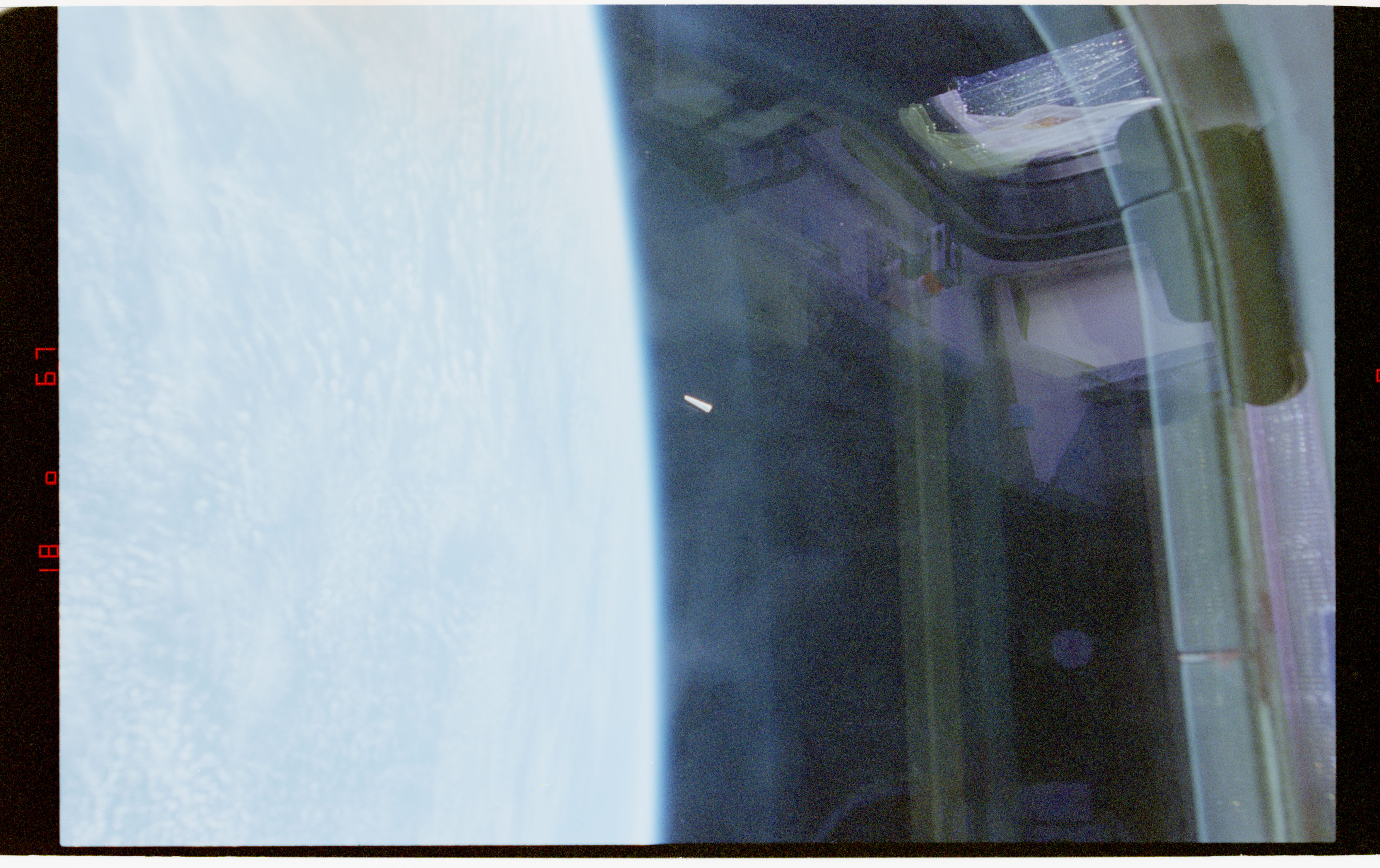
Among the 40 files in the fourth batch of the PURSUE declassification program, published July 10, 2026 on the Department of War's UAP portal, are three NASA images officially labeled "STS-80 Unidentified Object Image 1, 2 and 3, 1996." It is the first time material from that mission enters a formal UAP declassification channel — thirty years after the flight.
The mission is famous in its own right: STS-80 was the Columbia shuttle flight launched November 19, 1996 and landed December 7 — at 17 days and 15 hours, the longest of the entire Shuttle program. Aboard were five astronauts: Kenneth Cockrell, Kent Rominger, Tamara Jernigan, Story Musgrave and Thomas Jones.
What do the newly published photos show? They are film still photographs (the negative edges with frame numbering are visible), taken through the cabin window: in the first, a small elongated white object glows near Earth's limb; in the second, a white triangular shape appears right at the horizon; in the third, a tiny dark speck stands against daytime clouds. In all three frames, reflections of the cabin interior are visible on the glass. The government does not detail the exact day or camera.
A distinction almost all the press is missing: these photos are NOT the famous video. The STS-80 material celebrated in ufology is the December 2, 1996 sequence recorded by the payload bay's low-light camera — remotely operated from Houston, not by the crew — over Caribbean thunderstorms: slow discs, fast streaks of light, and a luminous burst near Puerto Rico. Related pieces, but different ones.
What proponents hold: image analyst Mark Carlotto (Ph.D. in electrical engineering) published in 2005 the most-cited technical analysis of the video. He concluded the fast objects "are not shuttle debris or meteors" — some follow circular arcs, one at an estimated 12 km/s — and called the Puerto Rico burst "one of the most unusual phenomena observed to date by the shuttle," though his hypothesis is not extraterrestrial: he proposes a new atmospheric phenomenon, related to sprites. A nuance that lends him credibility: Carlotto himself concedes the two slow discs — the video's most viral part — "are likely to be pieces of shuttle debris emerging from the spacecraft's shadow."
The skeptical view has a hard-to-beat source: Thomas Jones, who was aboard. His explanation: ice particles and debris drifting out of the cargo bay, tens of feet from the orbiter, lit in orbital twilight and sometimes pushed by thruster firings. "Nobody on the crew was looking out the window at these ice crystals or debris particles," he wrote. James Oberg, a 22-year NASA Mission Control engineer, calls it "twilight shadowing": particles "appear out of nowhere" as they emerge from the shuttle's umbra. As Carlotto's own paper records, when Oberg asked astronaut Story Musgrave in 1997, he assured him he saw nothing unusual on the flight. NASA never classified anything from STS-80 as anomalous.
"Unresolved" does not mean extraterrestrial: officials stressed the batch's cases remain "unresolved" because there is insufficient information for a definitive determination, not because they are linked to alien activity. And one detail we observed first-hand in the three photos: they are shot through the window glass, with evident cabin reflections — an additional mundane candidate no one is pointing out.
All three images at original resolution are now in Nodriza's Declassified archive, citing the official source, along with the 14 documents and 23 videos from the rest of Release 04.