'Use NASA for a cover': the 1963 memo on space fragments, and what the 72 pages around it tell
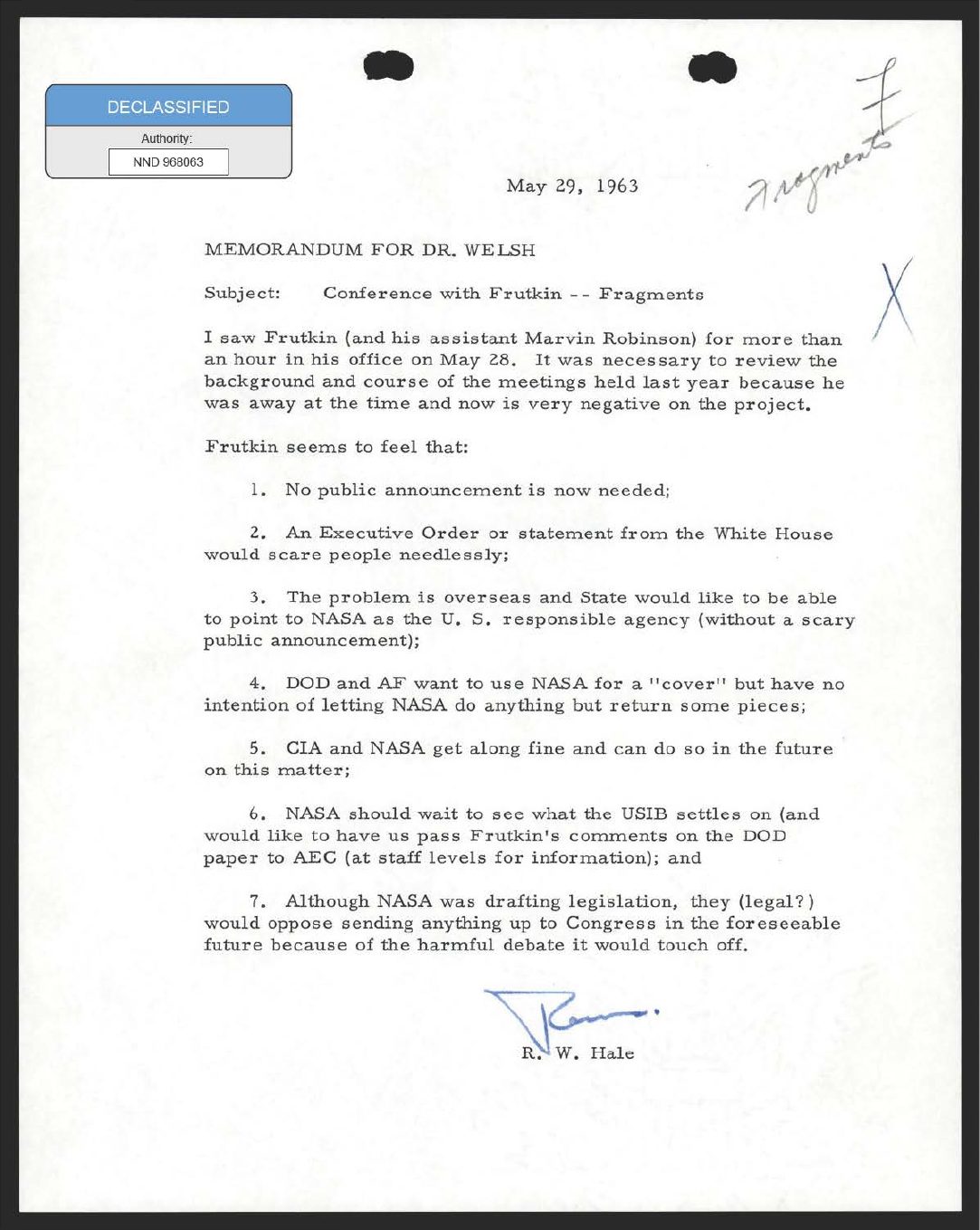
The seventh PURSUE release (war.gov/UFO, October 23, 2026) includes a one-page memorandum with a sentence that invites every reading: 'DOD and AF want to use NASA for a "cover" but have no intention of letting NASA do anything but return some pieces.' The same release includes a 72-page file on the same subject, published separately. We read both in full, and checked the quotes in this note against the image of each page, not only the extracted text.
The memo. It is dated May 29, 1963, and addressed to 'Dr. Welsh': Edward C. Welsh, executive secretary of the National Aeronautics and Space Council (NASC), the White House body chaired by Vice President Lyndon Johnson. It is signed by R. W. Hale of the council, and its subject is 'Conference with Frutkin -- Fragments'. Arnold Frutkin ran NASA's international programs office. Hale says he saw him on May 28 and that Frutkin 'now is very negative on the project'. According to Hale, Frutkin feels that no public announcement is needed; that an Executive Order or White House statement 'would scare people needlessly'; that the problem is overseas and the State Department would like to point to NASA as the responsible agency '(without a scary public announcement)'; the cover sentence; that CIA and NASA get along fine; that NASA should wait for what the USIB (the US Intelligence Board) settles on; and that, although NASA was drafting legislation, it would oppose sending it to Congress 'because of the harmful debate it would touch off'.
Fragments of what? The memo does not say. The 72-page file does: a folder from the Lyndon B. Johnson Presidential Library, from the files of Charles E. Johnson of the National Security Council staff, titled 'Space Vehicle Fragments – Responsibilities and Procedures'. These are fragments of satellites and rockets that fall to Earth.
The chronology these papers give is as follows. On October 2, 1962, Welsh writes to national security adviser McGeorge Bundy and NASA Administrator James Webb: someone has to decide which agencies handle 'obtaining, analyzing, and identifying' fragments that fall on US territory, and there are 'legal as well as operational problems'. A month earlier, on September 5, 1962, a roughly 20-pound piece of the Soviet Sputnik 4 had landed in a street in Manitowoc, Wisconsin. The United States displayed it at the UN, and the Soviet Embassy picked up what remained in January 1963. The file does not mention that case; the timing is our own observation.
During October and November 1962 two papers circulate: an unclassified public statement and Confidential 'Guidelines for Interagency Handling of Space Vehicle Fragments'. There is even a draft presidential memorandum that opens 'The President has approved the following procedures'; the file does not contain a signed version. A handwritten note from the November 6, 1962 meeting sums it up: the White House would clear the statement 'for release by NASA. NASA to publicize the program.'
The Confidential part explains the rest. The Defense Department's version of March 1, 1963 names NASA as the agency responsible for receiving and identifying fragments, but adds: 'To insure prompt analysis for intelligence purposes', NASA and other agencies will deliver to Defense, on a priority basis, fragments '(including whole vehicles)' launched from foreign countries. Defense keeps the ones it receives first 'for analysis', and then they go to NASA 'pending final arrangements for their return to the launching country'. In short: a civilian public face, and the foreign hardware goes first to military analysts. That is what Frutkin, according to Hale, called a cover. The file never uses the word.
NASA's objection is on paper too. In an undated letter to Welsh, Frutkin asks to delete precisely the clause letting Defense keep foreign fragments, because it is 'inconsistent' with NASA being the responsible agency.
Then there is the CIA. On December 7, 1962, Deputy Director of Central Intelligence Gen. Marshall Carter replies that the matter is 'of interest and concern to the United States intelligence community' and refers it to the USIB. Three days later, Charles E. Johnson describes a 'small hassel between DOD and CIA' over the paper and calls it 'a "tempest in a tea cup"' that would have been avoided had the space council brought the CIA into the committee from the beginning. On May 31, 1963, two days after Hale's memo, Welsh writes to CIA Director John McCone: the paper has 'top-level Defense clearance' but 'has not been coordinated within the intelligence community', and 'Considerable time has now elapsed'. In October 1963 Welsh presses again and calls new meetings for November. The file ends in 1964 with NASA press guidance on debris from its own Saturn rockets (flights SA-5 and SA-6). No final decision is recorded in the folder.
What is not there. We searched the whole text, and the images of the pages that had no text, for 'UFO', 'unidentified', 'flying saucer', 'extraterrestrial', 'Moon Dust' and 'Blue Fly'. Zero hits. Nor is any specific foreign incident named: the Soviet Union appears once, to compare the size of a NASA rocket with Soviet vehicles that had already reentered.
Some sentences invite over-reading. A 1964 press guidance says: 'Under no circumstances does this agency (government) conjecture on the origin of an object.' It continues: 'Rather, it desires to obtain, analyze, and attempt to establish the origin.' It is about debris from a Saturn rocket, and 'origin' means which country launched it.
And Moon Dust? In UFO literature, 'Project Moon Dust' is the name tied to the secret recovery of crashed craft. What is documented is something else: a real Air Force project to locate, recover and transport descended foreign space vehicles, and its rapid-transport arm, Operation Blue Fly, which came to light through freedom-of-information requests from the 1970s on. A 1961 document places them in the same intelligence structure as a program investigating UFO reports, and that is where much of the myth comes from. Even the 2026 coverage that revived it acknowledges that the documents 'stop short of proving' the recovered material came from extraterrestrial craft. These 1962–64 papers name neither Moon Dust nor any Air Force program. What they do show is what the government wanted foreign fragments for: intelligence analysis before returning them.
A cross-reference with another case in our archive: Welsh's same council was the one that, on November 13, 1963, asked the embassy in Brazil about an alleged sphere that had crashed in Bahia with a 'dead crewman'. The hoax was debunked within days. That the space council asked about a fallen object in those same weeks, while trying to close a procedure for space fragments, fits these papers. That is our reading; no document links the two files.
In short: the 1963 'cover' is a year-and-a-half bureaucratic fight among NASA, Defense, the CIA and the space council over who would be the public face and who would get the Soviet hardware first. It is not proof of a hidden UFO program, however it sounds out of context. The memo and the 72 pages can be read in full in our archive.