Skinwalker Ranch — what the Pentagon papers finally say
A 480-acre ranch in Utah's Uintah Basin that went from a farm with missing cows to the most famous paranormal ranch in the United States: a family that sold in fear, a millionaire who bought it to study it, a $22 million intelligence program and a reality show now in its seventh season. In October 2026, the seventh PURSUE release published for the first time the official report of the contractor that investigated it — and we hold it in full in our archive. Here is the whole story, checked against that paper: what holds up and what does not.
The Uintah Basin, in northeastern Utah — the ranch lies south of Fort Duchesne, beside the Uintah and Ouray Ute Reservation. Photo: BLM Utah, 2023 · public domain · via Wikimedia Commons.
The name — a Navajo concept on Ute land
The ranch lies south of Fort Duchesne, in Uintah County, beside the Uintah and Ouray Ute Reservation. But "skinwalker" (yee naaldlooshii) is a figure of Navajo folklore — a witch who takes animal form — and the Navajo Nation is some 400 miles to the south. The story television repeats is that the Navajo "cursed" the land of their Ute rivals. When journalist MJ Banias (Vice, 2020) put it to Betsy Chapoose, the Ute tribe's cultural rights director, she answered, laughing: "That is the first time I have ever heard that story… It's true that the Ute and the Navajo have had a strained relationship over land ownership, but I've never heard any stories about a curse."
What does have a documented history is UFO interest in the basin: science teacher Joseph "Junior" Hicks, of Roosevelt, compiled more than 400 sightings from the 1950s on, and biologist Frank Salisbury studied them in The Utah UFO Display (1974, foreword by J. Allen Hynek). Neither spoke of a cursed ranch.
Skeptical viewSkeptic writer Jason Colavito puts it plainly: the ranch's "mystery" is "entirely a modern creation, fabricated in the late twentieth century," bearing every hallmark of its era (cattle mutilations, UFOs, creatures). An honest note: we found no formal statement from the Navajo or Ute nations against the name or the show; the cultural-appropriation critique circulates, but not as an official tribal position.
The Shermans — June 1996
The case is born in print on June 30, 1996, with "Frequent Fliers?" by Zack Van Eyck in the Deseret News. Terry and Gwen Sherman said that over 15 months on their 480-acre ranch, they and their two children had repeatedly seen three kinds of UFO — a small box-like craft with a white light, a 40-foot object and a ship "the size of several football fields" — plus circles of flattened grass and lights emerging from "doorways" in midair. Seven cows: four vanished and three found dead and partially mutilated. Terry, who reluctantly agreed to talk: "I don't know really what to think about it." The article's last line: they "just want it to stop."
Skeptical viewWhat that first article does not say: there is no bulletproof wolf, no "skinwalkers," no Ute–Navajo curse. The giant wolf that took rifle shots without bleeding appears later, in George Knapp's reporting and the 2005 book. And skeptic Robert Sheaffer (Skeptic, 2020) adds a heavy fact: the family that lived there 60 years before the Shermans denies anything strange happened. His reading: "The parsimonious explanation is that the supernatural claims about the ranch were made up by the Sherman family prior to selling it to the gullible Bigelow." It is a hypothesis, not a proven fact. Another detail from the same 1996 article: the Shermans had not reported the mutilations or the UFOs to the authorities, and the Uintah County sheriff's office had no reports of either "in recent memory" — though Junior Hicks explained that many ranchers no longer report because "the authorities couldn't do anything."
Bigelow and NIDS (1996–2004) — "definitely no craft"
Weeks after the article, Las Vegas real-estate magnate Robert Bigelow flew to Vernal and offered about $200,000; the sale closed in September 1996 (Deseret News, Oct 20, 1996). The Shermans moved to a smaller ranch near Whiterocks, and Terry stayed on as a caretaker paid by Bigelow, under a non-disclosure agreement. The ranch became the field lab of the National Institute for Discovery Science (NIDS), founded by Bigelow in 1995 and run on the ground by biochemist Colm Kelleher; the team included John B. Alexander and physicist Eric Davis. Alexander promised at the time that results would be published "in scientific journals."
Robert Bigelow (2011), owner of the ranch from 1996 to 2016 and founder of NIDS and Bigelow Aerospace, whose subsidiary BAASS ran the AAWSAP contract. Photo: NASA/Bill Ingalls · public domain.
Skeptical viewSeven months later the same paper ran "No UFOs or ETs have dropped in at spooky ranch" (Apr 27, 1997). With scientists and a veterinarian manning an observation post, Alexander admitted: "Definitely no craft… Nobody has landed… There have been some minor observations, but nothing you would stand behind" — explaining that such phenomena "tend to be very fragile. It's like a watched pot." The sheriff's office had received no reports since the sale. Eight years later, NIDS's own book concedes: "we managed to obtain very little physical evidence of anomalous phenomena, at least no physical evidence that could be considered as conclusive proof of anything." NIDS disbanded in 2004, and the promised scientific papers never appeared.
What is claimedThe investigators' version is in Hunt for the Skinwalker (Kelleher and Knapp, 2005): years of incidents — the huge wolf, lights, mutilated animals, objects appearing and vanishing — told through witnesses under pseudonyms. For them the phenomenon was real but elusive, and seemed to "react" to attempts to measure it.
AAWSAP — the Pentagon comes to the ranch (2008–2010)
In September 2008 the Defense Intelligence Agency (DIA) awarded BAASS, Bigelow's company, the contract for the AAWSAP program — $21,948,810.00, per the original award held in our archive (D111). Officially it was a study of future advanced aerospace weapon systems; in practice it also funded the ranch investigation. According to Skinwalkers at the Pentagon (Lacatski, Kelleher and Knapp, 2021), the program was born after a DIA official's 2007 visit to the ranch, and was championed by Senator Harry Reid.
Skeptical viewThat origin story comes from the books and from press coverage relying on their authors; we did not find it in the papers released by PURSUE. What is on official paper is BAASS's fieldwork — and that is what follows.
What the Pentagon papers say (R7, 2026)
On October 23, 2026, the seventh PURSUE release published the file of the contractor BAASS (Bigelow Aerospace Advanced Space Studies), which worked for the DIA's AAWSAP program. There, finally on official paper, is the ranch investigation: the "Utah Ranch Investigation Report" of April 2010 (D174, 60 pages) and the November 2009 monthly report with the guards' logs (D173). A reading note: the document never writes "Skinwalker Ranch" — it says "Utah Ranch," with names redacted. That it is that ranch is our own inference from the places it mentions (Fort Duchesne, Bottle Hollow reservoir) and because the witnesses themselves speak of a "Skinwalker."
What BAASS did, per D174: two deployments (March 22–26 and April 19–23, 2010) with two investigators and two scientists; more than 25 in-person interviews with lifelong neighbors within a mile or two — 4 local police officers, 11 Native Americans (a shaman among them), the director of the local Fish and Wildlife office, 12 ranchers, 6 business owners and about 15 members of the Mormon Church; seven Moultrie game cameras with cards collected weekly; radio-frequency measurements; and plant bioassays.
What is claimedThe report's own summary of findings: 11 independent witnesses describe a large "dog" or "wolf"-like creature that walks and runs on two legs, some 6 to 7 feet tall ("there may be at least three separate types of creatures"); 4 witnesses, three-foot hairy "troll"-like creatures; and more than two, a huge "worm" (about 8 feet), a "pterodactyl"-like creature and "little people." One re-interviewed neighbor said that days earlier he had seen a "Skinwalker" that his dogs chased and that ran through a barbed-wire fence.
Skeptical viewWhat the report itself acknowledges: all of that is testimony, mostly gathered years later ("the vast majority… have allegedly occurred within the last five to seven years"). The map of the creatures' "lines of travel," with three intersection points, comes with the author's own caveat: those intersections "could be construed as arbitrary," since the creatures may have changed direction once out of sight. And the cameras: the report presents no capture of creatures or lights. The tobacco plants meant to spot under a mutagenic agent: "none are present."
A technical item, with our reading: at one point on the mesa two strong radio signals were measured (1210–1216 and 1232.5–1238.5 MHz) that had not been there the day before. The report notes those bands are allocated to exploration and navigation satellites, "primarily for military purposes." Our reading, not the document's: those ranges match satellite-navigation bands (GPS L2, Galileo/GLONASS) — an ordinary terrestrial or satellite source cannot be ruled out from a single measurement.
The "Skinwalker" DNA: dog and raccoon
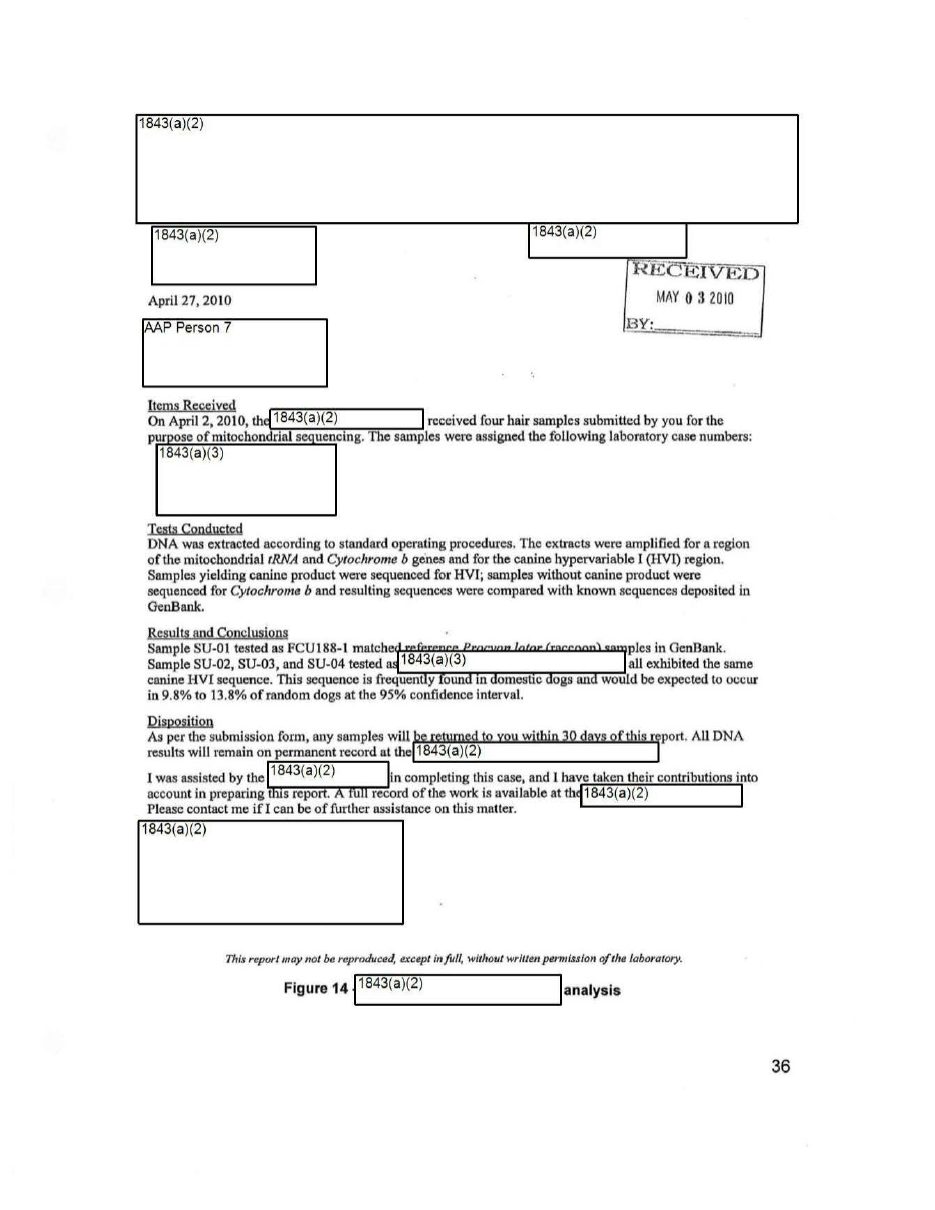
The jewel of the file. BAASS sent a lab four hair samples for mitochondrial DNA sequencing: hair embedded in a red-stained rock found on the mesa in January; short white hairs on the fence where, per the neighbor, "the creature" crossed; two unknown hairs found in a clump; and — as a control — hairs from one of the dogs of a property whose name is redacted. The lab report (April 27, 2010) is on page 37 of D174.
The result, on the original paper: SU-01 = raccoon; SU-02, SU-03 and SU-04 "all exhibited the same canine HVI sequence," frequent in domestic dogs (found in 9.8–13.8% of random dogs). From our copy of D174, p. 37 · public domain (DoW/PURSUE).
Result: the rock hair was raccoon (Procyon lotor) — BAASS's own email notes that several people at the ranch report raccoons near the homesteads, "so this finding would not be out of the ordinary." And the other three — the hair from the "Skinwalker" fence, the clump and the control dog — gave the same canine sequence. In the internal email (p. 38), BAASS concludes this suggests "the same canine individual (but not 100% definitive)," and that the physical similarity to the control hairs, plus the fact that those dogs "run at will on the property," strongly argue for it.
Skeptical viewThe nuance that separates this site from a headline: the lab did not say "same dog." It said the sequence is frequent in domestic dogs and occurs in roughly 1 in 8 dogs (9.8–13.8%). That identifies the species and rules out anything exotic, but it does not identify an individual. "Same dog" is BAASS's inference — reasonable, and flagged by them as not definitive. What does stand firm: the only physical trace of the "Skinwalker" ever analyzed turned out to be dog.
The guards' logs (2009)
BAASS kept round-the-clock surveillance from August 3, 2009, with security officers on the ranch (they appear as "Utah Ranch Security Officers" in the contractor's staffing plan). Their November 2009 logs (D173) are the most human material in the file. Almost every patrol ends the same way: photos and night-vision goggles, "no anomalies." But there are exceptions: a stereo that turned on by itself in homestead 1, tuned to the local country station (the power button is physical); the coin protocol — guards left pennies in a fixed configuration to see whether anything moved them: almost always "undisturbed," but one day one had been moved, with no footprints or wind, and a guard noticed the same with the coins on his nightstand; a single flash photo with an "orb"; and a guard who felt "a very threatening presence" in front of some trees at 1:30 a.m.
Skeptical viewWhat the same guard wrote next: he checked with the thermal imager and night-vision goggles — "Nothing showed up on anything" — and "the dogs did not seem to notice anything." That same night he describes a "very cold grip" on his ankle while trying and failing to wake. Our readings, not the document's: the latter fits sleep paralysis, well described in medical literature; and flash-photo "orbs" are the classic artifact of dust or moisture backscattering the flash. Neither proves nothing was there — but they are known explanations the file does not rule out.
The "hitchhiker effect" — and the database that does exist
The book Skinwalkers at the Pentagon (2021) recounts that people who visited the ranch reported phenomena that "followed" them home — the so-called "hitchhiker effect." The R7 papers do not narrate that, but they do show its scaffolding: in BAASS's November 2010 self-assessment (D175), the contractor's "Data Warehouse" lists "10. Utah Ranch Database" and "11. Post-Utah Ranch Effects Database" — a database of effects after the ranch — and says the ranch-database analysis looks for patterns in when anomalous activity is reported, to improve detection.
Skeptical viewThat the database exists is a documentary fact; that it holds the "hitchhiker effect" as the book tells it is our reading — the published file does not include its contents. And a database of reports records what people report: its existence does not validate the phenomena.
Fugal and the television era (2016–2026)
In 2016 Bigelow sold the ranch to Adamantium Real Estate, whose owner, Utah businessman Brandon Fugal, went public in 2020 (the price is reported inconsistently across sources; we do not treat it as settled). On March 31, 2020, History premiered The Secret of Skinwalker Ranch, with engineer Travis Taylor as lead scientist; in May 2026 it began its seventh season, and it had a spin-off (Beyond Skinwalker Ranch, 2023–2025).
What is claimedFugal says he went "from skeptic to experiencer." To KSL TV: "There is definitely an intelligence that exists on the property that is interacting with those that come and go." The show presents radio-frequency anomalies, radiation readings, GPS failures and objects in the sky.
Skeptical viewAfter five seasons, IFLScience summed up (2023) that the team "has yet to provide anything to back up their supposed experiences"; there are no peer-reviewed publications. On Metabunk, amateur analysts explained show "anomalies" as internal lens reflections and even a fly. And historian Barry Greenwood, reviewing Skinwalkers at the Pentagon for the Journal of Scientific Exploration (2023), describes the case as "a blizzard of this type of information: sensational, lurid, and chilling but always hitting a brick wall when it came down to being able to prove" it — anonymous witnesses, medical data shielded by privacy law that no one can check, camera-carrying investigators who do not photograph what they say they see — and flags a conflict: Taylor was at once a scientist for the Pentagon's UAP task force and a star of the reality show.
State of the case
Three decades, three owners, an intelligence program and seven television seasons later, the documentary balance is this: abundant testimony, carefully gathered; no capture from BAASS's cameras in the report; bioassays with no signal; a trajectory map its own author calls potentially "arbitrary"; and the only physical trace of the "Skinwalker" that ever reached a lab — dog hair, plus raccoon hair. On the other side, serious people — neighbors, police, armed guards — describing in detail things they cannot explain, and a file the Pentagon paid for and finally released.
Why it is here. Skinwalker Ranch is the most famous paranormal case in the United States and, until October 2026, one of the least verifiable: nearly everything came from books and television made by the people investigating it. Now the official paper exists — and we host it in full, with every quote linked to its page. What that paper says is less spectacular than the legend and more interesting than the mockery. Here nothing is invented.