The most famous UFO case in the world: a military press release announcing a "flying disc," a retraction within hours, and half a century of spy balloons, bodies nobody saw in 1947, forged documents and a town turned into a mecca. We gather all of it — what is claimed and what investigation answered, with the source in plain sight.
"RAAF Captures Flying Saucer On Ranch in Roswell Region" — front page of the Roswell Daily Record, 8 July 1947. Public domain.
What happened (1947)
In early July 1947, William "Mac" Brazel, foreman of the Foster ranch near Corona, New Mexico — some 120 km from Roswell — found a field of scattered, shiny debris. On 6 July he reported it to the Roswell sheriff, who alerted the RAAF airbase. The next day Major Jesse Marcel, intelligence officer of the famous 509th Bomb Group (the atomic-bomb unit), and Captain Sheridan Cavitt went to collect the material.
What is claimedDecades later, Marcel and his son described extraordinary material: a foil that crumpled and unfolded itself ("memory metal") and rods bearing purple-hued symbols like hieroglyphs. Brazel said it was "nothing like" the weather balloons he had found on the ranch before.
Skeptical viewThe description Brazel gave the press in 1947 was far more modest: strips of gray rubber, tinfoil, tough paper, balsa sticks and "tape with flowers printed on it," a bundle of about 1.5 kg. The "memory metal" and "purple hieroglyphs" are late testimony (post-1978), not from the 1947 record. Captain Cavitt later signed a sworn statement: "I thought at the time, and think now, that this debris was from a crashed balloon."
The press release and the retraction
On 8 July 1947, Lieutenant Walter Haut, on orders from base commander Colonel William Blanchard, issued a stunning press release: the 509th's intelligence office "was fortunate enough to gain possession of a disc." The Roswell Daily Record headlined: "RAAF Captures Flying Saucer On Ranch in Roswell Region." Within hours the debris was flown to Fort Worth, where General Roger Ramey re-labeled it before the press as an ordinary weather balloon with a radar target. Interest evaporated.
Ramey and Colonel DuBose pose with the debris in Fort Worth, 8 July 1947 — flimsy-looking material the Air Force presented as a balloon. Photo: Fort Worth Star-Telegram · public domain.
What is claimedIn one of the few photos of the material, Ramey holds a typed sheet. Ufologist David Rudiak claims to read phrases in it such as "victims of the wreck" and "the disc" — which would prove the "balloon" was a cover story and that there really was a craft (and victims).
The "Ramey memo": the sheet the general holds in his hand. Opposite readings have been made from this grainy photo. Photo: J. Bond Johnson, 1947 · public domain.
Skeptical viewThe so-called "Ramey memo" operates "at or just above the noise level of the image": different analysts read different words (e.g. "remains" instead of "victims"). It is a classic case of pareidolia over a grainy photo; there is no confirmed text. Rudiak's reading is disputed interpretation, not fact.
The official explanation: Project Mogul
In 1994, after a request from Congressman Steven Schiff, the Air Force identified the origin of the debris: Project Mogul (1947–49), a top-secret program that used long "trains" of polyethylene balloons with microphones to detect Soviet nuclear tests at high altitude. The candidate for the ranch debris is NYU Flight #4 (~June 1947). The radar reflectors on those trains were balsa-and-foil — and the "flowered tape" Brazel saw matches the decorated reinforcement tape from a toy maker used on them, as physicist Charles Moore testified firsthand.
A Project Mogul "train": dozens of balloons, radar reflectors and microphones hanging tens of meters. Diagram from the USAF report, 1995 · public domain.
What is claimedIt is the USAF's official explanation, in the report "The Roswell Report: Fact vs. Fiction" (1994/95, ~1,000 pages): the debris was Mogul, not a craft. It fits every detail of the 1947 material — the foil, the balsa, the rubber, the flowered tape, and the secrecy that would explain the military fuss.
Mogul's corner radar reflectors: balsa sticks, foil and the reinforcement tape with toy-maker figures — the real source of the "purple hieroglyphs" described as alien. USAF, 1995 · public domain.
Skeptical viewHonesty, because the moat is to sweep nothing under the rug: proponents object that Flight #4 does not appear in NYU's formal records — only in scientist Albert Crary's diary, whose 4 June entry reads "no balloon flights again on account of clouds." Moore reconstructed the trajectory without tracking data. The Mogul explanation is a very strong, documented inference, not a flight proven on paper. (Separately: the GAO confirmed in 1995 that the RAAF's outgoing messages from that period had been destroyed, while concluding nothing about UFOs.)
The bodies and the late witnesses
This is worth stressing, because it is the backbone of the moat: Jesse Marcel never spoke of bodies. The "alien bodies" entered the story with the 1980 book, not with the 1947 witness. Almost all the body witnesses surface only in the 1980s and 1990s, decades later, with alien culture already in place.
What is claimedThe most cited is Glenn Dennis, a mortician who said the base asked him about child-size coffins and that an Army nurse described autopsies of small bodies to him. Others — Frank Kaufmann, Gerald Anderson, Jim Ragsdale — added intact craft, recovered beings and military clean-up operations.
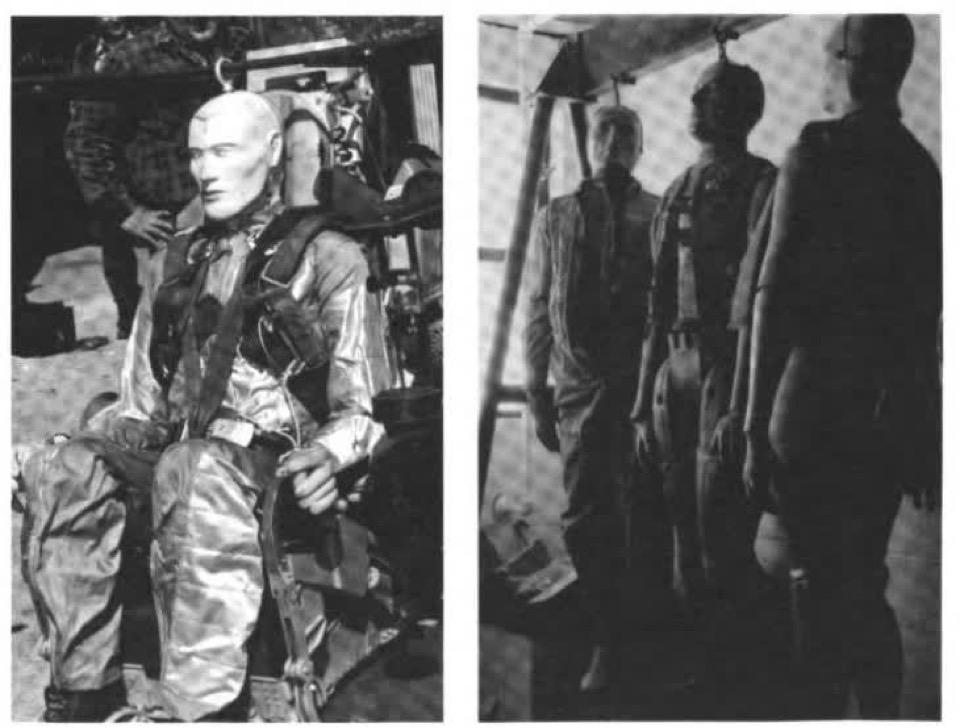
Skeptical viewHere the case weakens badly. Dennis told it ~45 years later and gave a nurse's name that never existed → investigators deemed him "impeached as a witness" (and he co-founded the UFO museum: conflict of interest). After Kaufmann died, forged military documents were found among his papers; Anderson produced a "1947 diary" written with ink that did not exist in 1947. The USAF report "Case Closed" (1997) attributed the "bodies" to anthropomorphic dummies dropped by balloon in the 1950s — but the objection is obvious: the dummies are from 1953–59 and the incident is from 1947. The USAF rescues it with "time compression" (witnesses merging memories across years); even skeptics consider this second report the weaker of the two.
The "bodies" per the USAF: a "Sierra Sam" in a silver flight suit (left) and Alderson dummies (right), "of the type dropped from balloons at off-range locations throughout New Mexico during the 1950s." Figs. 21-22 of the "Case Closed" report (McAndrew, 1997) — USAF photos, public domain. Note the "shiny silverish gray" suit: it is what the late witnesses described on the "beings."
The revival (1978–1980)
After the 1947 correction, the case vanished for about 30 years. In 1978, nuclear physicist and ufologist Stanton Friedman happened to interview retired Major Jesse Marcel, who told him the "weather balloon" had been a "cover story." That revived everything.
It was amplified by the National Enquirer (1980) and, above all, by the founding book "The Roswell Incident" (Charles Berlitz and William Moore, October 1980) — the dominant version of the 1980s. It was that book which introduced the alien bodies into the story, thirty years after the events. (A note of honesty: Marcel's own military record contained documented exaggerations — he claimed to be a pilot and to have shoot-downs he did not have — which means his testimony must be handled with care.)
Majestic 12
In December 1984, producer Jaime Shandera received in the mail an unmarked roll of film with two documents: a Truman memo (1947) authorizing "Operation Majestic-12" and a briefing to Eisenhower (1952). They described a secret committee of 12 created to handle crashed alien craft, Roswell included. Stanton Friedman was their main defender.
Skeptical viewThe FBI declared them "BOGUS" in 1988 — the word scrawled on the file itself — after consulting the Air Force. Analysts documented devastating anachronisms: Truman's signature is a pasted photocopy from a real 1947 memo; the date format and typography do not match 1947/52 (they point to a 1960s machine); a "Cutler–Twining" memo bears a date when Cutler was out of the country. The consensus, among skeptics and archivists: forgery.
The "alien autopsy" (1995)
In 1995, British businessman Ray Santilli released black-and-white footage claiming to show the autopsy of a Roswell alien; Fox aired it in August 1995 and it became a worldwide sensation. (The video is copyrighted — it is only described here; Nodriza neither hosts nor links it.)
Skeptical viewIn 2006, Santilli admitted he and his partner created the footage: a sculptor built fake bodies (molds filled with raspberry jam, sheep brains and chicken offal) and played the pathologist, filmed in a London flat. Santilli called it a "reconstruction" of a supposedly lost original — a claim no one has been able to verify. It is one of the best-known hoaxes in the field.
The cultural footprint
Today "Roswell" is synonymous with UFO. The town opened the International UFO Museum and Research Center in 1991 (it passed 5 million visitors by late 2023) and holds the Roswell UFO Festival every July — on the 75th anniversary (2022) it drew over 40,000 people and a direct economic impact of about USD 2.2 million. The name merged with Area 51 and with Independence Day, The X-Files and the series Roswell until it became a global pop icon.
Even the streetlights in Roswell have alien eyes. Photo: CGP Grey · CC BY 2.0.
Why it is here. Roswell is the case where it is easiest to pick a side and stop thinking. Nodriza does the opposite: it places the real 1947 press release next to the Mogul explanation, separates what a witness said at the time from what a book added thirty years later, and names the frauds (MJ-12, the autopsy) without pretending they topple everything else. The honest question is not "aliens yes or no?" but "what does each document say, and from when is it?" Here nothing is invented.