Tic Tac / USS Nimitz 2004 — the case that changed the conversation
Four U.S. Navy aviators, an Aegis cruiser tracking objects for days, an infrared video authenticated by the Pentagon and sworn testimony before Congress. The definitive modern UFO case — and also the best example of how serious skeptical analysis answers it. We gather all of it, with the source in plain sight.
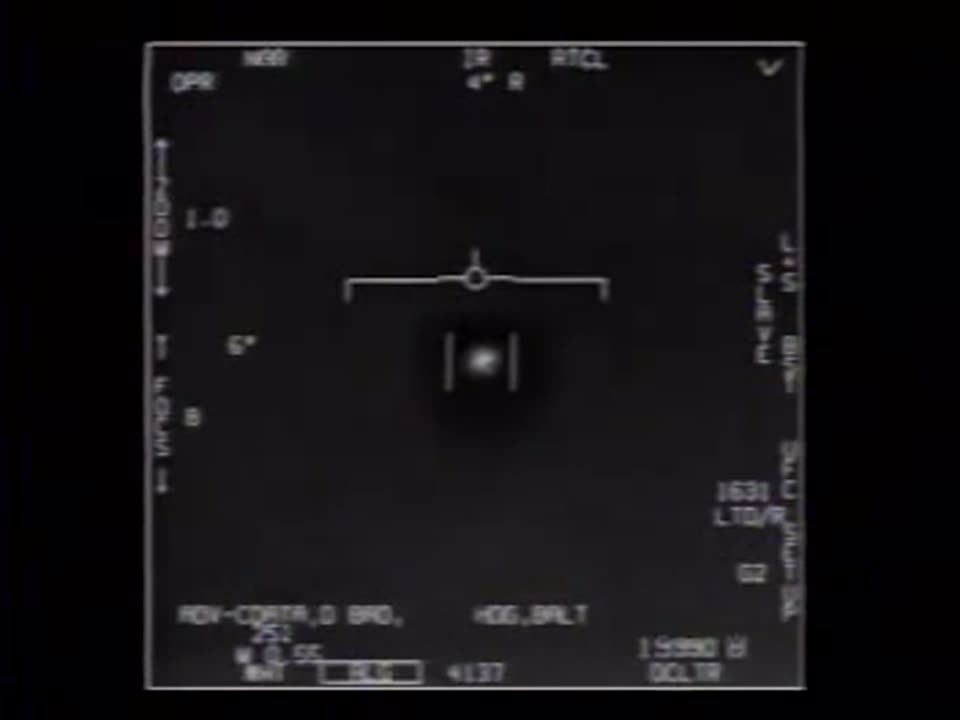
Frame from the FLIR1 video, recorded by an F/A-18F's ATFLIR camera on 14 November 2004. U.S. Navy · public domain · hosted in our archive.
The setting (November 2004)
November 2004, some 60-100 miles off San Diego and Baja California. The USS Nimitz Carrier Strike Group (carrier CVN-68, the Aegis cruiser USS Princeton, destroyers and a submarine) was running pre-deployment exercises before heading to the Persian Gulf. Hardly a setting prone to fantasy: it was one of the most sensor-saturated environments on Earth, with the Princeton's freshly recalibrated SPY-1B radar.
The Princeton's radar
What is claimedFrom around November 10, Operations Specialist Senior Chief Kevin Day began seeing strange radar tracks near San Clemente Island: "they were appearing in groups of five to 10 at a time… there were 28,000 feet going a hundred knots tracking south." Aegis technician Gary Voorhis confirmed that after recalibration "the tracks were actually sharper and clearer." Per David Fravor's testimony to Congress, the objects had been observed for ~2 weeks: descending from above 80,000 feet to 20,000, loitering for hours and climbing back up.
Skeptical viewHonesty with the numbers: no original radar file is public. Altitudes differ by teller — Fravor says "over 80,000 feet"; the leaked 2009 "Executive Summary" says ~60,000 and descents "down to approximately 50 feet in a matter of seconds" — and all of them are operators' recollections, not verifiable telemetry. That is the difference between testimony (strong, multiple, consistent) and hard data (absent).
The encounter: November 14
That day, two F/A-18Fs from squadron VFA-41 "Black Aces" — Commander David Fravor with his weapons systems officer, and Lieutenant Alex Dietrich with hers — were diverted from an exercise by the Princeton toward a real-world contact. Arriving, they first saw the churning water: a patch of foam on a calm sea, "as if the water were boiling." And above it, low, a white object.
What is claimedFravor, under oath before Congress (26 Jul 2023): "[I] saw a white Tic Tac object with a longitudinal axis pointing north south and moving very abruptly over the water like a ping pong ball. There were no rotors, no rotor wash, or any sign of visible control surfaces like wings." About 40 feet, smooth, unmarked. As he descended toward it, the object mirrored him (climbing as he came down), and as he closed to half a mile it "rapidly accelerated and disappeared right in front of our aircraft." Seconds later the Princeton reacquired it on radar: 60 miles away, in under a minute, exactly at the jets' assigned rendezvous point. He told the NYT: "It accelerated like nothing I've ever seen." Dietrich, on 60 Minutes: "if I saw this solo, I don't know that I would have come back and said anything, because it sounds so crazy when I say it."
Skeptical viewWhat the skeptic can say here is limited, and it should be said plainly: the visual encounter is the testimony of four aviators — credible, trained, consistent and under oath, but testimony. The "churning water" exists only in the accounts (when they looked back, it was gone); the "size of a 737" comparison is TV narration that appears in no sworn statement. Nothing of the visual encounter was recorded.
The FLIR1 video
The famous video was not shot by Fravor. It was shot by a second flight launched hours later: WSO Chad Underwood locked the ATFLIR camera onto a radar contact 30-40 miles out — with no visual contact. It is ~90 seconds of infrared. The video and Fravor's encounter are two separate events on the same day that almost always get fused into one — we will not do that here.
Full FLIR1 — U.S. Navy, 14 Nov 2004, officially released by the Pentagon on 27 Apr 2020. Public domain · hosted and preserved in Nodriza's archive. — file page in our archive →
Skeptical viewThe most-cited technical analysis is Mick West's (Metabunk): the object's final "jump" — the video's most striking moment — coincides exactly with the camera losing track lock and switching zoom from 1x to 2x; the object was drifting the same way the whole time. And the "wingless" silhouette is consistent with the infrared glare of a distant jet's engines seen from behind, which fattens the shape and erases the wings — West reproduced it in simulation. His key point: the video, on its own, demonstrates nothing anomalous.
What is claimedFravor's reply (to Lex Fridman, 2020): "It's funny how people who have never operated the system can extrapolate things" — and that the video is the least of it: the strength of the case is four visual witnesses plus an Aegis cruiser tracking for days, none of which a video analysis explains. West, in turn, concedes his analysis is about the video, not about what Fravor saw. That is where the front line sits.
2017: the case goes public
The case slept for thirteen years. On December 16, 2017, the New York Times revealed the Pentagon's secret AATIP program (with Luis Elizondo as its public face after resigning) and published the Nimitz encounter with the FLIR1 video. It is the story that opened the modern UAP era. The Navy confirmed in 2019 that the three circulating videos were real and classed them as "unidentified aerial phenomena," and on April 27, 2020 the Pentagon released them officially "to clear up any misconceptions about their authenticity."
GIMBAL and GOFAST (which are NOT from the Nimitz)
A clarification almost all the press skips: the other two famous videos, GIMBAL and GOFAST, are not from 2004 or the Nimitz — they were recorded in 2015 off the U.S. East Coast (USS Theodore Roosevelt group). They were released together, hence the confusion. All three are hosted in our archive.
GIMBAL (2015, East Coast) — with the pilots' original audio: "look at that thing, it's rotating!" U.S. Navy · public domain · hosted at Nodriza. — file page in our archive →
Skeptical viewGIMBAL: for West, the famous "rotation" is an artifact of the camera's own gimbal mechanism: the object would be the glare of a distant jet's engines, and since glare forms in the non-rotating part of the optics, when the pod rotates to reframe, the glare rotates, not the object (each rotation is preceded by a camera "bump," and other artifacts in the video rotate in sync). Metabunk's own threads concede some ATFLIR details are not public — solid, but not 100% closed. GOFAST: here the skeptic has the government on his side: triangulating from the display's own data, the object flies at ~13,000 feet, slow (~40 mph), consistent with a wind-borne balloon — the sense of speed is parallax from the filming jet. The Pentagon's AARO office published that same analysis, and NASA's UAP panel (2023) presented it too.
GOFAST (2015, East Coast) — AARO and NASA calculate a slow object at high altitude (parallax). U.S. Navy · public domain · hosted at Nodriza. — file page in our archive →
Congress and the government
On July 26, 2023, Fravor testified under oath before Congress (alongside Ryan Graves and David Grusch). The 2021 ODNI report left 143 of 144 UAP cases "unresolved" for lack of data — while attributing none to extraterrestrial technology. And AARO's first director, Sean Kirkpatrick, left saying (Scientific American, 2024) he found no evidence of extraterrestrials and that his work was "overwhelmed by sensational but unsupported claims." "Unidentified" does not mean "alien" — it means data is missing. The Tic Tac remains, formally, unresolved.
What is disputed
What is claimedThree items circulate as "hard proof" and must be weighed: (1) the "confiscated radar data" — Kevin Day and sailor Patrick Hughes recount that after the incident "two unknown individuals" took tapes and drives without a log; (2) the 2009 "Executive Summary" (13 pages, leaked in 2018), which narrates the case in detail; (3) the Knuth paper (Entropy, 2019), calculating accelerations of ≥5,370 g for the Tic Tac.
Skeptical view(1) The "confiscation" has no documentary confirmation; former naval aviators offer the mundane alternative that tapes were routinely reused. Fravor himself stated in writing: "the incident was never investigated, none of my crew were ever questioned, tapes were never taken." (2) The 2009 document has no author or letterhead and the Pentagon never acknowledged it; it was likely produced by private contractor BAASS, and rests on interviews, not telemetry (Fravor calls it "the Unofficial Official Report"). (3) Knuth's calculation is correct math over unverifiable inputs: distance and timing come from operators' recollections; if the inputs fail, the 5,370 g falls with them.
Why it matters
The Tic Tac is the case that moved the UFO subject from the tabloids to the New York Times, the Pentagon and Congress. Not because it proves visitors — it does not — but because it gathered what almost no case gathers: front-line military witnesses, sensors, authenticated video and official process. And it is also the method's best lesson: the same case carries extraordinary sworn testimony AND a skeptical analysis that dismantles its videos piece by piece. Both fit on the same page. Both are here.
Why it is here. The Tic Tac is the gold standard of the modern case and of the Nodriza method: the three official videos live in our archive in the public domain, the sworn testimony is quoted verbatim with its transcript, and the skeptical view sits beside it, not in a footnote. You decide with the evidence in front of you. Here nothing is invented.