Calvine 1990 — the "best UFO photo" and its 32 years of silence
A huge, silent diamond over the Perthshire moors, a military jet passing by, six photographs a newspaper never published, a ministry that studied and "lost" them, a press officer who kept a copy for 32 years — and a photographer nobody has found. It is the UFO photo with the best documentary pedigree in the United Kingdom, and its Ministry of Defence file sits complete in our archive, with our own OCR. Here is the full story: what holds up and what does not.

The account — August 4, 1990
On the evening of August 4, 1990, two young men who worked in the kitchen of a Pitlochry hotel were walking the moors above Calvine, a hamlet in Perth and Kinross beside the A9 road, some 13 miles north of Pitlochry. By their account, they saw a huge, grey, silent diamond-shaped object hovering motionless for about 10 minutes while a military jet passed nearby. They took six colour photographs before the object shot vertically upwards at great speed and vanished. When they got home they called Glasgow's Daily Record.
The chain — a newspaper that never published
The Daily Record received photos and negatives — and never published the story. It sent a 10×8-inch print to Craig Lindsay, the RAF's press officer for Scotland at RAF Pitreavie Castle, who interviewed one of the witnesses by phone and faxed copies to the Ministry of Defence in London. The negatives reached the MoD on September 10, 1990. And there the story sank for three decades: the paper stayed silent, the ministry filed it away — and Lindsay kept his print in a drawer for 32 years. When someone finally called him, in 2022, he answered: "I have been waiting more than 30 years for someone to call me about this story… and you are the first person to do so."
The MoD file — in our archive
The contemporary Calvine paperwork fits in three folios inside file DEFE 24/1940/1 ("UFO reports", Aug 1990–Jan 1991): an Air Staff secretariat loose minute dated September 14, 1990, drafted with defensive lines ("If Pressed") because the Daily Record was expected to publish. That complete file — 156 pages — now sits in full in our declassified archive, with our own OCR: uk-calvine-1990. We downloaded it from The National Archives with a free download order (the "£3.50 wall" is false: with an account it is free).
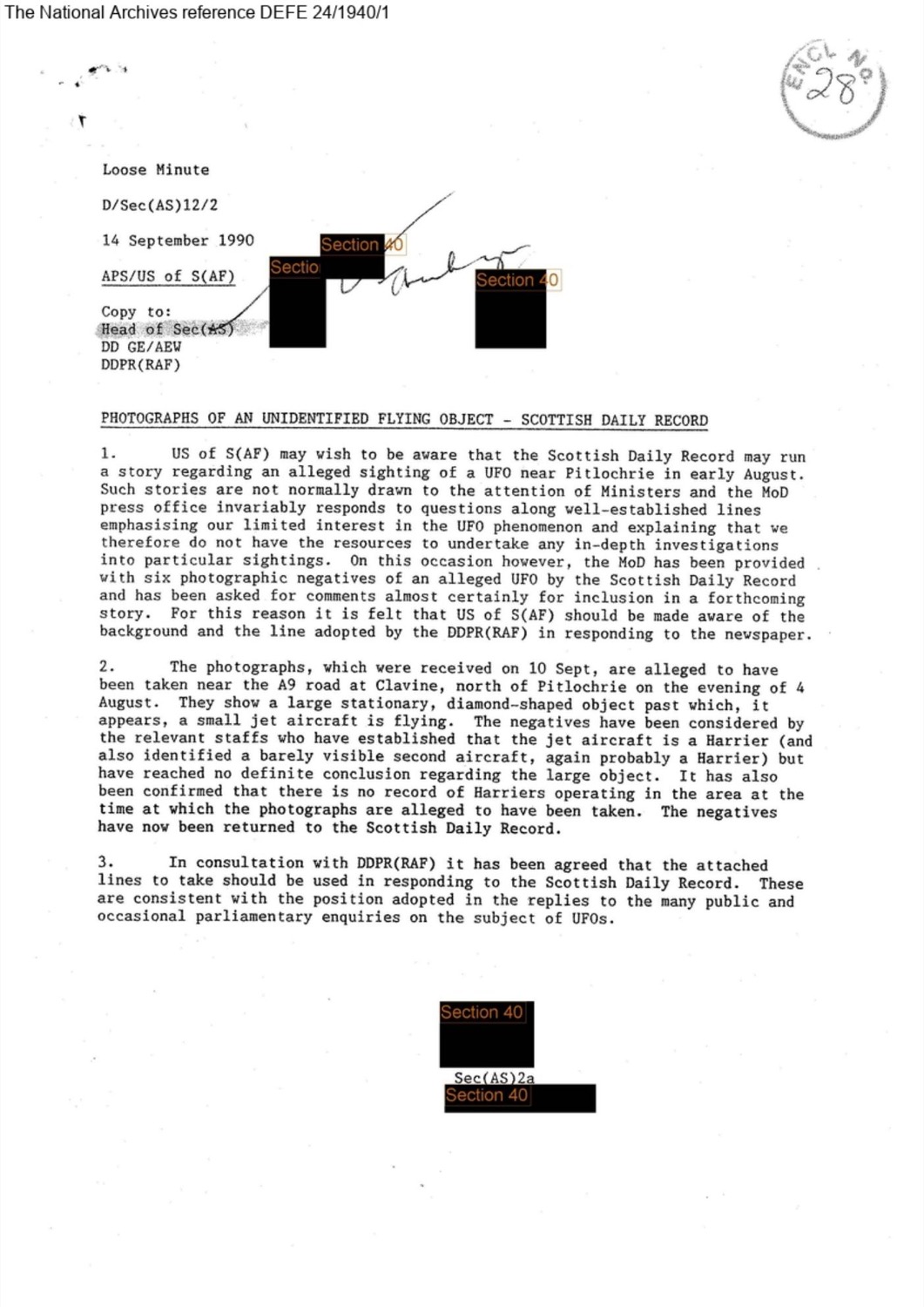
What that briefing says, verbatim (it is in our OCR): the analysts identified the jet as a Harrier (plus a barely visible second aircraft, "again probably a Harrier"); they reached "no definite conclusion" about the diamond-shaped object; and — the line that has drawn the most attention — "there is no record of Harriers operating in the area at the time." The ministry's public line, then and in 2022: the negatives were examined and not retained as they contained "nothing of defence significance."
The Whitehall poster and the lost negatives
Inside the MoD the photo did impress. In January 1992 the negatives went to JARIC (the air reconnaissance intelligence centre), which produced analysis transparencies; the intelligence branch DI55 got involved; and in December 1992 there was an exchange with the United States. Nick Pope, who ran the ministry's "UFO desk" from 1991 to 1994 (he inherited the case; he did not handle it in 1990), recounts that a poster-sized blow-up hung for years on his office wall — until his division head, convinced it showed a secret prototype aircraft, took it down. Then, nothing: a July 1996 parliamentary question was answered with the ministry having "no record" of the photographs; the MoD says it returned the negatives to the Daily Record; nobody at the paper confirms it. The six negatives remain missing.
2022 — Lindsay, Clarke and the recovered photo
Dr. David Clarke (Sheffield Hallam University, former curator of the MoD's UFO files at The National Archives) had hunted the photo since 2009. Thirteen years later a lead took him to Craig Lindsay, by then retired; in May 2022 he travelled to Scotland, and Lindsay donated the original print, the photocopies and even the envelope to the university's special collections. The image was published on August 12-13, 2022 and went around the world as "the best UFO photo ever taken." We only LINK to it, we do not host it: its legal author remains unidentified (it is, in practice, an orphan work) — it can be seen on Clarke's blog or on Wikipedia (fair use).
The academic analysis fell to Andrew Robinson (Senior Lecturer in Photography, Sheffield Hallam). His conclusions, in his words: the image is "a genuine photograph of a scene before the camera," with no sign of in-camera or post-production manipulation — and "if the image is the result of a hoax, no evidence of this is present in the image": any trickery happened in the scene, not in the picture. The print is a 1990 colour-paper positive, mini-lab-made from a copy negative — consistent with newspaper practice of the day. If distant, the object would measure ~30-40 metres across; the jet is consistent with a Harrier. His bottom line is the whole case's: "there is insufficient data to reach any conclusion regarding what the unidentified object might be."
The hypotheses — from Aurora to a Christmas ornament
With the photo public since 2022, the explanations compete — and none has won.
"Kevin Russell" — the ghost photographer
The back of Lindsay's print bears, in red chinagraph pencil: "Copyright Kevin Russell c/o Daily Record, Glasgow." Clarke's team contacted over 400 Kevin Russells. In 2023 the Daily Record published a photo of a man by that name who worked in Pitlochry's hotel trade in 1990; tracked down in 2024, he denied all knowledge — and cannot explain why his name is on the print. The paper denies ever employing him; the MoD keeps the photographer's name redacted in the file under data protection (that is the only closed part of the record — until 2076). In 2024 a former chef added another layer: he recalled the two photographers terrified, and a visit by "three men" in uniform to the hotel — his word alone, uncorroborated. To this day, nobody has claimed authorship of the UK's most famous UFO photo.
State of the case
In August 2025, some 150 people packed Blair Atholl's village hall for the 35th anniversary; Craig Lindsay, aged 86, was still telling the story in person. The case, as of 2026: a genuine photograph per the academic analysis, an unexplained scene, an unidentified photographer, lost negatives, and an official file — the one in our archive — that ended, like everyone else, with no definite conclusion. Calvine is exactly the kind of case this site exists for: neither "solved" nor "proof of aliens" — a first-rate documentary mystery, with every paper in plain sight.